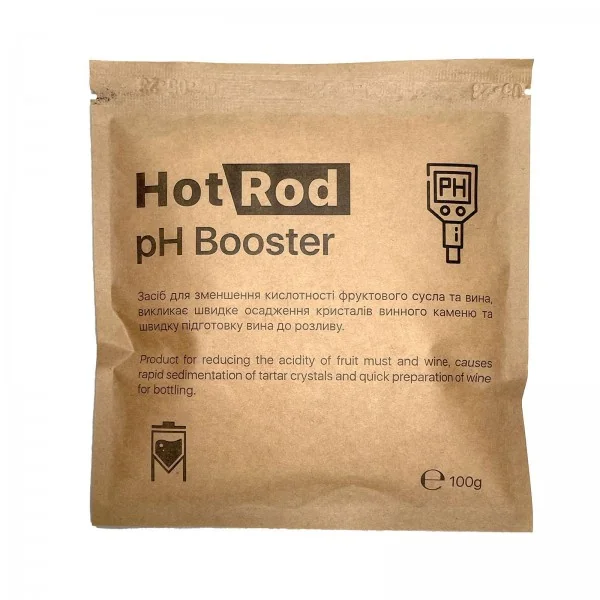
Must Acidity Regulator Hot Rod pH Booster (100g)
Mărește
Delivery in Chișinău: 24h
Warranty 24 months
Return 14 days
Must Acidity Regulator Hot Rod pH Booster (100g)
A low pH level in the must can be a problem when fermenting fruit must, especially when using concentrated juices. High acidity can hinder the fermentation process, slowing it down or even stopping it completely. This can lead to a low alcohol yield and a poorer quality product. The Hot Rod pH Booster acidity regulator can help solve this problem by allowing the pH level in the must to be increased and improving fermentation conditions. Hot Rod pH Booster is designed to rapidly precipitate tartar crystals and speed up the preparation of wine for bottling. Raising the pH level of fruit must: Measure the initial pH of the must using a test strip or pH meter. Add 2 g of Hot Rod pH Booster per liter of must for fermentation. This will raise the pH level by approximately 0.6. Stir thoroughly. Measure the pH of the must again. If necessary, add more Hot Rod pH Booster to reach the desired pH level. Continue fermentation as usual. Precautions: Do not use too much Hot Rod pH Booster to avoid exceeding the desired pH level. Do not store the product in places with high humidity or temperature. Avoid contact with skin and eyes. Removing tartar and adjusting wine pH level: After the fermentation process and the wine maturation period are complete, transfer the wine to another container. Determine the acidity of the wine using test strips or a pH meter. Measure the required amount of Hot Rod pH Booster according to the recommendations. Add Hot Rod pH Booster to the wine and stir thoroughly. A reaction between tartaric acid and potassium bicarbonate will begin immediately. Allow the wine to rest for 24-48 hours at a temperature between -4 and +4 degrees Celsius so that the tartar settles to the bottom. At room temperature, this process may take much longer. Separate the wine from the tartar by racking it off, ensuring that the tartar does not get into the wine. Repeat the process if necessary to achieve the desired acidity. Recommended dosage – 13.5 g per
| Product type | additive |
|---|